
Institutional Ownership of SFR: Real Numbers
Institutional Ownership of SFR: Real Numbers
President Trump’s proposed ban on institutional single-family home purchases, formalized in a January 2026 Executive Order, triggered immediate market volatility and a rare bipartisan legislative push. While major rental REITs like Invitation Homes and American Homes 4 Rent saw their stocks tumble, industry groups warned the move could stifle the "build-to-rent" supply needed to ease the housing shortage. In March 2026, the Senate passed the 21st Century ROAD to Housing Act with an 89-10 vote, targeting investors with 350+ homes. However, the policy remains stalled in the House due to a controversial "forced sale" provision that would require institutional owners to divest properties after seven years, a clause critics label as unprecedented government overreach.
In Arizona, the effort to curb corporate home ownership mirrors the national push but has faced significant legislative hurdles. In early 2026, state lawmakers introduced the "Own Something and Be Happy Act" (HB 2325), a bipartisan-supported measure that proposed a 50-home ownership cap for institutional investors and a 60-day "first look" period for individual homebuyers. Despite aligning with President Trump’s national policy, the bill was sidelined in March 2026 after the House Commerce Committee chairman declined to grant it a hearing, citing concerns over government interference in private property rights. Although a final-hour attempt to revive the cap via a floor amendment also failed, the bill's sponsors have vowed to reintroduce the proposal in 2027, characterizing the fight as a necessary "guardrail" to ensure Arizona families aren't squeezed out of the market by Wall Street.
Let’s get to real numbers.
According to SFRA at www.sfranalytics.com, there are 2,420 operators that hold 354K single-family rentals in the 100–1,000 unit range nationwide, which is the cutoff suggested in a recent Wall St. Journal article. Using that definition, investors who own 1,000+ properties account for roughly 1% of the nation's single-family housing stock, while in Phoenix, the figure is much higher, at about 2.9%.
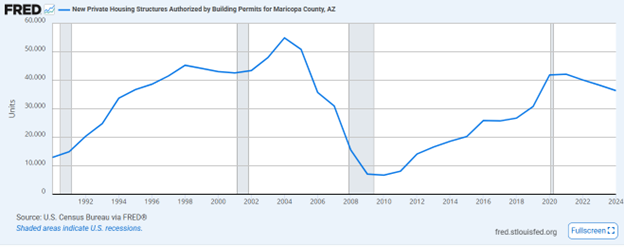
It’s worth remembering why institutional buyers were attracted in the first place. In 2019, back when the building boom began, the vacancy rate was at a historic low of under 5%, and rents were still over $1,000, making the math pretty compelling for building a rental portfolio. And indeed, that attracted a lot of investment. And in Phoenix, more than the national average. And while average rents have reached about $2,200 in 2026, which sounds great until you factor in that 1 in 8 units sit vacant, and there are still about 22,000 units under development.
What’s next?
The data suggests that the peak of institutional acquisition is already in the rear-view mirror for Phoenix. Many large operators bought heavily post-GFC but stopped acquiring as prices rose; in fact, 34% of mid-market operators have not purchased a property in the last two years. And the probability of forced selling is remote and even if implemented, not a short term impact
Further, it doesn’t really seem necessary, as the Phoenix market has already undergone a visible "overcorrection" cycle. Moving from the massive construction boom and record-high completions in 2024 of around 24,920 units, which we pointed out in this publication in our April 2024 discussion, the market is now in a "digestion" phase. New starts fell 50% in 2025 as the market began to overcorrect on the downside.
The headlines suggest a major problem. The data suggests something more modest and is already well into resolution mode. Institutional ownership remains a small share of the housing market, even in Phoenix. More importantly, the conditions that drove heavy buying have already reversed. Higher prices, rising vacancies, and excess supply have cooled demand and slowed acquisitions. Politics will do politics, but the market is well into correcting itself. Phoenix is not in crisis, in either direction. It is in a normal, if uncomfortable, adjustment phase.
If we didn’t live in Phoenix, we could visualize this as driving a swerving car on an icy street. What is the right thing to do in that situation? Foot off the gas and keep the car pointed down the road, while ignoring the screaming passengers. Sounds like good advice now, too.